Search

Search My Garden Blog with Google Custom Search
Showing posts with label Hiking. Show all posts

23.11.15

Matthiessen State Park

Do you, like me, have a craving for adventure, but feel like you can't get up and go because you don't have friends and family that want to participate in activities like hiking? Growing up in Chicago, I never knew of people that went hiking or visited state parks. REI offers a number of classes, outings, and Events. I was invited to participate in an outing to Matthiessen State Park last year and kept putting it off. I finally got around to taking REI up on their generous offer to do an outing after Thanksgiving.

 REI tour guides Matthiessen State Park

The REI outing started early one crisp, fall morning in Chicago. After we stood around getting acquainted and drinking coffee, the group and guides loaded up into the van. The trip to Matthiessen State Park in North Utica, IL., took a couple of hours. If you've ever driven through IL you understand that it isn't a very scenic drive, unless you consider rows and rows of corn to be scenic. Once we arrived at the park, the group got pointers on staying warm and dry during the hike.

REI Hiking Matthiessen State Park

The walking sticks were a good idea. It was still pleasant outside for that time of year, but there was definitely a bit of snow and ice on the ground that made walking difficult. Oh, and the mud and slippery leaves. I recommend taking walking sticks on your hikes to help you find secure footing and to help you up and down sleep slopes.

Osage Oranges Matthiessen State park

I had procrastinated in choosing my outing, and was kicking myself for waiting so long and not taking an earlier outing where there would have been more plants to see. But once we got underway I realized that there is just as much interest for plant lovers in fall and winter. Take the picture above for example. Have you ever seen an Osage orange? I'd never seen one in person myself. That morning when I posted pictures on social media, I learned that most people know them as hedge apples. Contrary to their common names, they are not related to oranges or apples.

Creek with exposed sandstone rock

The constant flow of water exposes the sandstone below the surface in this creek. We don't have geography like this in Chicago.

Log covered with moss

Matthiessen is also home to a lot of mosses, lichens and mushrooms. I couldn't help but kneel down and take pictures.

Mushrooms on log Matthiessen State park

Even this late in the season there are still signs of the mushrooms that thrive in the area.

Poison Ivy Matthiessen State park

Does this look familiar? Well, if you are going to spend time hiking in the woods it would be smart to learn to identify poison ivy. The guides quickly pointed it out and made it a point to mention that even when it isn't leafed out, poison ivy will still irritate your skin.

Mathiessen State Park Hiking

This day I learned just how noisy a forest is; it was an odd experience for someone like me. Trees make a lot of noise as the bang together and sway in the wind. It sounded as if a tree would fall on me any moment.

Hiking trail closed sign

Unfortunately, some of the trails were closed for repairs, or because the time of year made them dangerous to hike on. I was particularly bummed that we could hike down to the Vermilion River, but what I was able to see between the trees was beautiful. I made a note to return and see it one day.

Birdhouse Prairie Connector

Because of the closed trails, we took a detour and walked across the Prairie Connector. Going from feeling secluded among trees to standing in the middle of a prairie took some getting used to. You realize just how strong the wind is and noisy in an open prairie.

A photo posted by @mrbrownthumb on

On the hike we were joined by Lenore Sobota, at docent at Starved Rock state park. Her expertise came in handy during the walk through the prairie connector when we encountered animal droppings and signs that a furry animal had met an untimely demise. She even found a bald eagle feather on the trail, which gave us a clue as to what may have found a meal here.


Bridge Matthiessen State park

Looking down into the bridge that spans the canyon.

Matthiessen State park bridge

Looking towards the other side of the canyon through the bridge.

A photo posted by @mrbrownthumb on

Matthiessen State Park was once private property and operated as a private park. Evidence of this can be seen by the extensive network of trails, but also in the permanent features like this beautiful stone bridge that spans the canyon. Here's a video of the decent into the bridge on my Instagram page.


Canyon Matthiessen State park

Taking the staircase off the side of the bridge leads you down into the canyon. It is so beautiful and the canyon walls tower over you on both sides. It is amazing to realize that a steady flow of water over many years was able to carve this. View this short video of the inside of the canyon on my Instagram page.


Keep walking through the canyon and you'll end up at Cascade Falls.

Cascade Falls Matthiessen

The falls weren't doing much cascading, but you can see that water does run here. If you look up photos of these falls online, you will find some with some impressive pictures of ice covering this area.

Cascade Falls

Here is a photo of a family taking pictures at Cascade Falls to give you an idea of just how deep below the surface you are in this canyon.

Matthiessen State park

Because of how soft sandstone is, the canyon is always changing. Water seeps into the stones, becomes frozen and splits open the walls of the canyon. That is how the small caves here are formed

A photo posted by @mrbrownthumb on


Evidence of the canyon being created by water can be seen in the numerous boulders in the floor of the canyon.

Rock with a face Matthiessen State Park

The coolest bolder in the canyon is a rock with a face carved into it. Some people say it looks like Spongebob Squarepants. Do you see it?

Tree roots Matthiessen State park

The canyon floor is full of so much beauty. Just look at this tree's root buttress exposed by the flow of water. After some more exploring around the canyon it was time to head back up to the surface and leave Matthiessen State Park. Check out this video from above the canyon looking down towards the cave and rock face pictured above to give you an overhead view of the canyon.
 
Fort Matthiessen State park

We walked back through the canyon, and up the bridge to walk through the other side of the canyon. Only to be confronted by a wooden staircase to take a bridge that leads to an old fort from where we would head back home. I don't mind telling you that my legs were killing me by this point and I was ready to sit. But it was the kind of pain that makes you feel like you did something.

If you're looking for an adventure check out the workshops, classes and trips available through REI. A big thanks to REI for gifting me this trip to see a part of the state I have lived in most of my life that I had never seen before.

Have you ever been to Matthiessen State Park before? If not, you should go. Opt Outside this holiday season.

5.12.14

A Grand Time at Grand Teton National Park

The last day of #ALEX14 was very bittersweet. That morning we woke and the participants separated into two groups. The group I was on decided to take a horseback ride along the trails that surround Togwotee Mountain Lodge. I decided to take the horseback riding excursion because I had never been on a horse before, and I figured if I was going to ride a horse for the first time, doing it in the American West was pretty appropriate.

The trails around Togwotee were just as scenic and interesting as any hikes within the national parks themselves. I wish we had spent some time just wandering around because throughout the horseback ride, we kept spotting animal tracks, and I even saw some Indian Paintbrushes blooming. Castilleja linariifolia, as it is properly know, is the state flower of Wyoming. Sadly, I didn't get a chance to take many photos during the ride since I was focused on staying on my horse, but I did get an opportunity to participate on the I’m on a meme, even if it was a few years late.
A video posted by @mrbrownthumb on
Later that afternoon we met with a photographer from National Geographic and posed for a group photo before taking a boat ride. It was the anniversary of 9/11 and the American flag fluttered behind the boat as we go our first close-up view of the glacier at the top of the Grand Tetons. During Day One of #ALEX14 we met Kevin Schneider, Deputy Superintendent of Grand Teton National Park, who said he considered the National Park Service to be an extension of the armed forces. In the way the military protects our country at home and abroad, the National Park Service protects the interior of our country.


I didn't understand it at the time, but that afternoon on the water, with the flag fluttering in the wind, I totally got it. Not only do the members of the National Park Service act as guides and interpreters of the parks, but they are there to protect us from the wildlife, the wildlife from us, and ensure that people and development don’t encroach on protected land.


Later that evening we went to a sunset dinner where we met David Vela, Superintendent Grand Teton National Park, who is the first Latino to serve as a superintendent of a national park. It was fun hearing Superintendent Vela’s story of how to got to this point of his career, and the connection he had with Grand Teton National Park as a youth, and how his life has come full circle.

I thought the highlight of this dinner was going to be me going beyond my comfort zone and eating elk. I had no idea I would be meeting an historic figure, and that the superintendent would be swearing us in as Junior Rangers and giving us our own badges. Granted I’m a little older than Junior Rangers normally are, but this moment solidified what I had been feeling about national parks, and Grand Teton National Park in particular. I felt like the parks were part of me and that I was leaving part of me behind in the parks I had visited.

                                   Sorry for the blurry David Vela photo of our swearing-in!

There is currently a lot of discussion about how the parks can be more inclusive and how park attendance can reflect the diversity of America. In the months that I've been back home from this trip, whenever I talk to people about it, they always mention that the National Park Service is desperate to reach new, diverse members. The national parks are prohibited by law from spending money on advertising--which I think is just ridiculous--so it isn't as a simple as saying they should create an ad campaign that targets a diverse pool of Americans, and their problems will be solved.

It's going to take a solution that is very nuanced, and some playing mediator between the different groups that may encounter themselves in national parks for the first time.

During one of our group meals there was an instance where a table of diners left the restaurant we were eating at because they said we were “too loud.” Granted we were a large group and some of the decibel levels could be attributed to Latin@s being naturally loud. If you come from a big family you learn early on in life that you have to make yourself heard or be forgotten. I wasn't offended by this slight. If anything, I was perplexed by the how quiet people were after spending a day seeing the most glorious scenery and wildlife. I felt like shouting about all the amazing things I had seen, not sitting quietly with the only other sound being the clinking of silverware on plates. The people around us sometimes acted as if they were at a funeral, while our group behaved more like we were at a birthday party.

There's going to have to be some outreach and cultural exchanges and understanding between people who are familiar with visiting national parks and those of us who are new to them. The National Park Service is going to have to convince many people who partake in the American tradition of vacation road trips in order to get us on the road visiting many parks a summer. But we'll get there, and the parks and our country as a whole will be better off. This trip was described as being a once in a lifetime experience. I don’t see it that way at all. I came away feeling like I had been baptized into a new lifestyle and can’t wait to visit more national parks, and sharing experiences like this with members of my family, especially the younger children who I hope come to love the national parks. See Day One of #ALEX14 and Day Two of #ALEX14, and Day Three of #ALEX14 if you are planning a trip to Grand Teton National Park on your next vacation.

What is #ALEX14 ? It is the hashtag of the American Latino Heritage Fund Expedition for 2014. In its second year, ALEX is an effort to introduce the national park system to a new generation of Americans who will in turn introduce the national parks to other Americans who have never been or are even aware that visiting national parks is even an option. Eight Latin@ blogger and social media influencers were selected by the National Park Foundation to tour the Grand Teton National Park and discover our role in the future stewardship of national parks. The trip was made possible through partnerships with Go RVing, Aramark, Columbia, Alaska Airlines and REI who generously paid for accommodations, clothing, food and travel costs.

Are you planning on visiting any national parks soon?

8.10.14

West Thumb Geyser Basin Yellowstone National Park

Day Two of #ALEX14 was pretty inspiring, what with the hike up Jenny Lake to Inspiration Point. But it would pale in comparison to what the National Park Foundation had in store for the third day. On this day we would hit Grand Teton National Park and make our way up to Yellowstone National Park and spend the morning at the West Thumb Geyser Basin.


After a hearty breakfast at Togwotee Mountain Lodge, we met with Sean Beckett a biologist and guide with the Teton Science Schools' Wildlife Expedition. Sean is also a photographer and blogger. You can find his blog at The Green Man Blog. In particular, check out his amazing series of posts on the phenology of Yellowstone, since it coincides with this post. I don't know where those bears were when we went looking for them, but I'm glad to see them in photos at least.


This day would teach me that you can't visit an area like Grand Teton National Park and Yellowstone National Park and get everything out of the experience unless you are going with someone who knows the area like the back of their hand. So, if you're ever visit Grand Teton or Yellowstone National Park, I recommend booking guided trips with Teton Science Schools.

Grand Teton Willow Flats

This day gave me the opportunity to try my new Canon PowerShot G16 that I purchased to take pictures on this trip. All of the photographs of in this post were taken with the PowerShot G16. The photos I used in the posts for Day One and Day Two were taken with my phone, a Samsung Galaxy S3, and my Canon Rebel XT DSLR Camera. We started the morning at Willow Flats, an area where you can actually see a lot of wildlife. Animals come down and give birth here and leave their offspring in the willow bushes. The willow bushes act like a Faraday cage for the scents of the babies. The bushes keep the scent of newborn calves down and out of the air where it could be picked up by predators.

West Thumb Geyser Basin, Yellowstone

A relatively short drive that morning took us to the West Thumb Geyser Basin at Yellowstone National Park.
Unfortunately, the road that leads to Old Faithful was closed during the trip, but the geysers here more than made up for it. I'd never seen anything so enchanting in my life. The colors at the hot springs and hydrothermal vents were mesmerizing. This was a cold morning and I'm glad it was that cold because we got the full effect of visiting hot springs. One moment your teeth are chattering, and then you're engulfed by hot steam rising from the spring and vents.

West Thumb Geyser Basin

Yellowstone West Thumb Geyser Basin

The West Thumb Geyser Basin overlooks Yellowstone Lake, the largest lake at high elevation in North America. Every day the geyser basin pours 3, 100 gallons of hot water into the lake. Surprisingly, all of that hot water does little to change the temperature of the lake.

Geyser Basin, West Thumb

Given how beautiful the area is, it was no surprise that there were busloads of tourists here that morning. Trying to take pictures when you’re surrounded by throngs of tourists is a little difficult so I forgot to make not of the names of all the springs and geysers as I was taking pictures. But I think this may be the Abyss Pool at the Geyser Basin.

Geyser Basin Water Crust

Just look at these beautiful colors in the pools of the geysers. The colors are a result of the microorganisms that live in the waters. The crust at the pools is very fragile and you can quickly find yourself submerged in water reaching 200 F in some of the pools. We were told the boardwalk you use to traverse the geyser basin has to be regularly maintained because it breaks down really fast.

Bones in Geyser Basin, Yellowstone

Anyone thinking of a dip into these pools would quickly meet the fate of the elk that fell into the pool and was boiled last winter. Can you see the bones?

Hot Springs Geyser Basin, Yellowstone

It's hard to depict how eerily beautiful it is to walk along the hot springs at this geyser basin. When the steam rises people can disappear and appear seemingly out of nowhere. See this Instagram video I took at Black Pool to give you an idea.

Big Cone Geyser, West Thumb Geyser Basin

Big Cone Geyser at West Thumb Geyser Basin juts out into Yellowstone Lake. Eruptions from this geyser are rare and only reach a couple of feet high. But you can see Big Cone letting of just a hint of steam in this pictures.

Yellow Monkey Flower

According to my Mac's Field Guide to Yellowstone & Grand Teton National Parks: Trees & Wildflowers this is a Yellow Monkey Flower, and they can even be found blooming among the geysers in winter because the warmer temperatures.
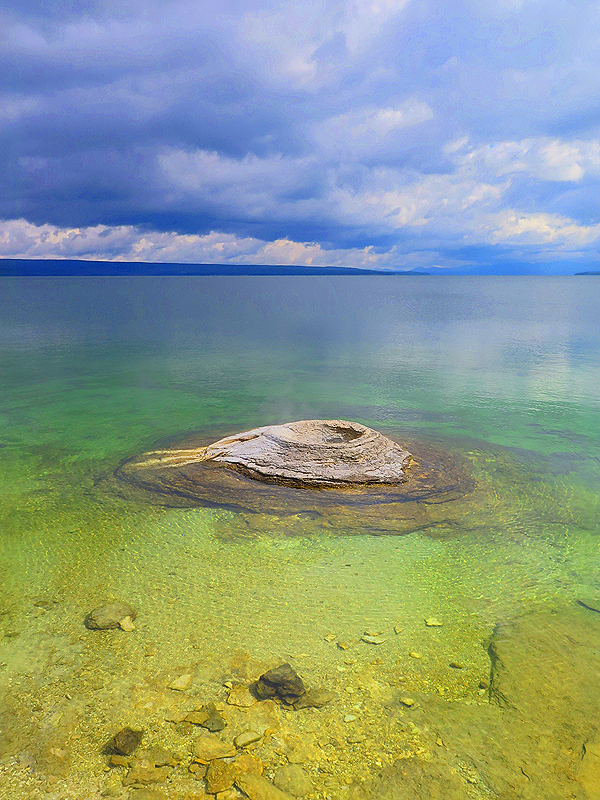
Fishing Cone Geyser

Fishing Cone geyser overlooking Yellowstone Lake. Back in the day, it was popular to fish at Fishing Cone geyser because you could catch a trout in the lake, swing your pole around, dip the fish into the cone and cook the fish without taking it off the line. Due to damage caused by fishing at Fishing Cone, fishing is no longer allowed here.

Lakeshore Geyser West Thumb Geyser Basin

Lakeshore Geyser, West Thumb Geyser Basin. Although it often erupts a few feet, the last time this geyser erupted with any significant force was in the 1970s. The smaller of the two geysers is usually not exposed until mid to late August.

Sean told us that all the hot water that is sent into the lake allows the shoreline to be used by animals in the dead of winter. So you can go in winter and find animals drinking from the lake when it has frozen over.

Seismograph Bluebell Pools, West Thumb Geyser

Seismograph Bluebell Pools, West Thumb Geyser Basin.

Seismograph Bluebell Pools

Seismograph/Bluebell Pools, West Thumb Geyser. These were renamed Seismograph Pools after the 1959 Hebgen Lake earthquake. Nobody is sure what changes occurred here to warrant a name change, but I like Bluebell Pools name better because there were bluebells blooming near here. The muddy pools are caused by the mud pot runoff nearby.

After a too short visit to the geysers, we stopped an had lunch before continuing with the rest of our adventure.

Grand Canyon of the Yellowstone

The Grand Canyon of the Yellowstone River. Sean kept mentioning that we were going to the the "Grand Canyon" and I almost had to pull out Google Maps to make sure I knew what state I was in. It turns out that there is a Grand Canyon of the Yellowstone River. Yes, Virginia, there is another grand canyon in America.

When we arrived here I was ready to pitch a fit because there were throngs of tourists on buses arriving. I had to push my way through people to get this picture. And then Sean says, "Come with me, I know a better spot for pictures."

Yellowstone River

After a hike that seemed to take all of five minutes and we were at the top of the canyon looking down on the Yellowstone River from the top. It was secluded and quiet but I didn't manage to overcome by fear of falling into giant canyons to get really close. One of the other bloggers on the trip would later says that she had this odd desire of jumping into the canyon. Which I found funny because to me the canyon was very evocative of something in the way Georgia O'Keeffe paintings are evocative of something. It had an oddly inviting feel to it.  


Here's a panorama of the Grand Canyon of the Yellowstone that I took with my phone. I decided to include it even though it wasn't taken with the camera mentioned above because the pictures didn't quite depict the vastness of the canyon.

Lower Falls of the Yellowstone River

Lower Falls of the Yellowstone River from the top of the canyon. On the way back to the car I found myself picking up candy wrappers and small pieces of trash that was left behind by the visitors on the tour buses. And I was feeling that same annoyance I feel when I pick other people's trash out of my garden. I guess this was the moment that I began to feel a sense of ownership of this land. I was all in, as they say. 'This Land is Your Land' played in my head on the car ride to the next location.

Waterfall

A short drive, u-turn, a quick hike down a woodland path, and Sean delivered us a pristine waterfall where many selfies were taken.


The day with an amazing sunset back where we started at the started and we even caught a glimpse of a bald eagle and a buck with his harem at the willow flats. It was a perfect end to an amazing adventure. I'm glad we had Sean and Grand Teton Science Schools with us this day because it felt like visiting an area with a friend who knew all the cool spots where you wouldn't be surrounded by tourists.

...this land is my land...

Don't miss my posts on Day One at the Phelps Lake, Day Two at Jenny Lake. Have you ever been to Yellowstone National Park? Did you get a chance to see bears?

What is #ALEX14 ? It is the hashtag of the American Latino Heritage Fund Expedition for 2014. In its second year, ALEX is an effort to introduce the national park system to a new generation of Americans who will in turn introduce the national parks to other Americans who have never been or are even aware that visiting national parks is even an option. Eight Latin@ blogger and social media influencers were selected by the National Park Foundation to tour the Grand Teton National Park and discover our role in the future stewardship of national parks. The trip was made possible through partnerships with Go RVing, Aramark, Columbia, Alaska Airlines and REI who generously paid for accommodations, clothing, food and travel costs.